Chronicles of Great Vedic Astronomy & Lore
Rediscover the towering scientific and spiritual heritage of India's master astronomers and philosophers.
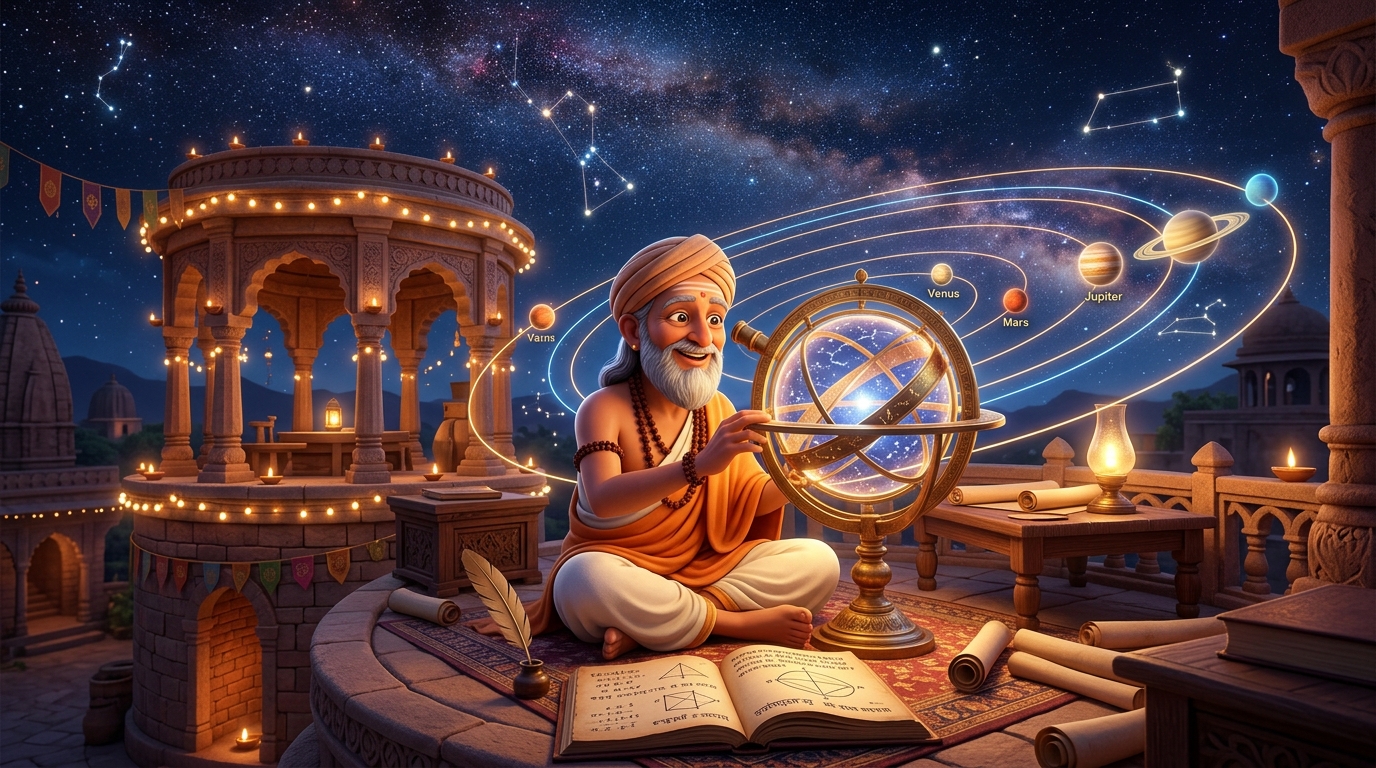
Aryabhata: The Mathematical Visionary of Earth's Rotation
More than a millennium before Copernicus, Aryabhata mathematically established that the Earth is spherical and rotates on its own axis. In his magnum opus Aryabhatiya, he calculated:
- The length of the sidereal year as 365 days, 6 hours, 12 minutes, and 30 seconds.
- Scientific explanation of solar and lunar eclipses without superstition.
- Precise approximation of Pi (π ≈ 3.1416) as an irrational constant.
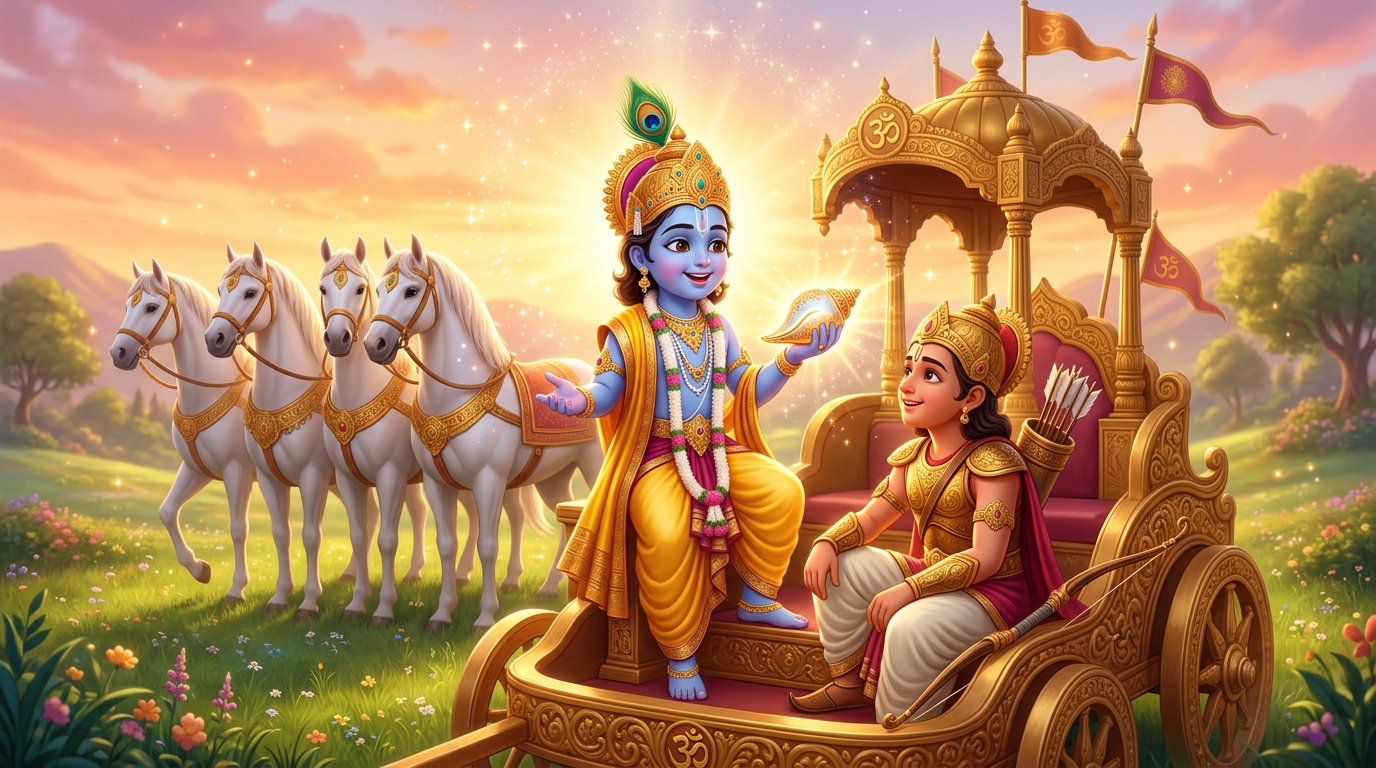
Shri Krishna's Timeless Counsel: The Chariot of Destiny
The Bhagavad Gita reminds every seeker that planetary influences represent the seeds of past actions, but your conscious will (Purushartha) in the present moment is supreme:
“उद्धरेदात्मनात्मानं नात्मानमवसादयेत् । आत्मैव ह्यात्मनो बन्धुरात्मैव रिपुरात्मनः ॥”“Lift yourself through your own mind; do not degrade yourself. For your mind alone can be your greatest friend, or your worst enemy.” — Bhagavad Gita 6.5
Varahamihira: The Tri-Skandha Master of Astronomy & Natural Science
In ancient Ujjain, the prime meridian of classical Indian astronomy, Varahamihira united three branches of Jyotisha: Ganita (astronomical calculations), Hora (natal horoscopy), and Samhita (mundane cosmic phenomena).
His monumental encyclopedia Brihat Samhita documented planetary movements, cloud formations, rainfall forecasts, groundwater detection, and architectural ergonomics (Vastu Vidya) with razor-sharp empirical scrutiny.
“There is no sacred knowledge superior to Jyotisha for understanding the interconnected rhythms of the microcosm and macrocosm.”